How Beekeeping Is Helping Emily Rebuild Her Livelihood in Oil-Affected Buliisa
In Uriibo Village, Buliisa Sub-county, where oil and gas developments are changing land use, livelihoods, and community life, Emily Facwan has found hope in beekeeping, an activity that protects the environment while bringing her to economic independence.
Fwacan, 56, is a project-affected person in Buliisa District whose land was taken to pave way for oil well pad. Like many women living in Uganda’s oil-producing communities, her life has been shaped by land loss, uncertainty, and the pressure to find new ways of earning a living. When part of her land was compulsorily acquired for oil infrastructure development, the change was not only physical. It affected farming, which was her main source of livelihood and the future she had worked hard to build.
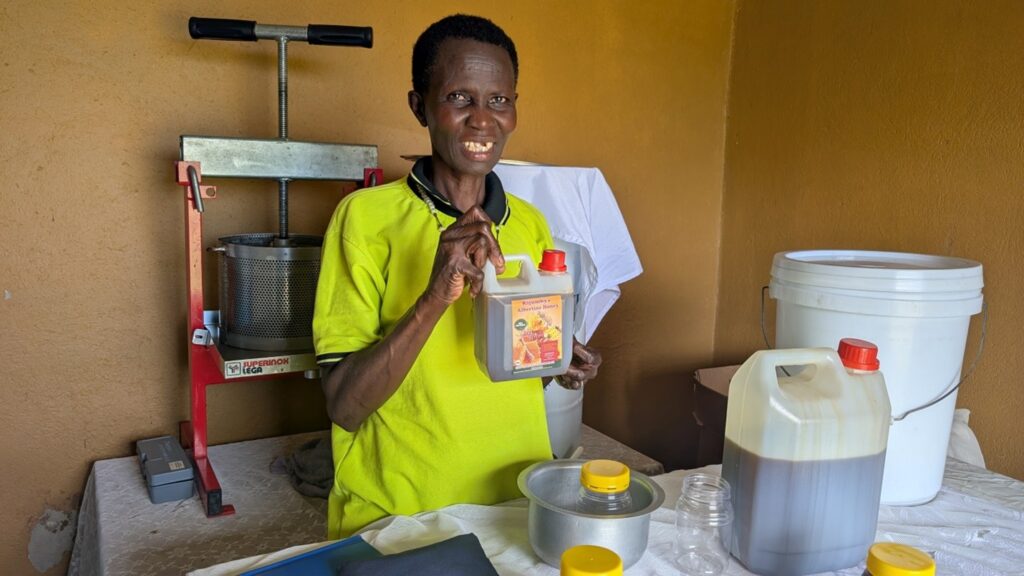
Figure 1: Fwacan Emily showing honey for Kijumbya community group that she has processed and packed
But Fwacan did not give up. She turned to beekeeping; a skill she had first learned from her father.What began as family knowledge later became a practical tool for survival and community transformation. In 2009, Fwacan received government support that helped her expand her beekeeping enterprise. Since then, she has continued to grow the business, using it not only as a source of income, but also as a way to protect the environment around her.
“Beekeeping does not require much land, and it encourages us to plant trees,” Fwacan says. “It also helps increase crop yields through pollination.”
For women affected by land acquisition, this matters deeply. Many traditional livelihoods in Buliisa depend on access to land for farming, grazing, and natural resource use. When land becomes limited, women often carry the heaviest burden because they are responsible for feeding families, caring for children, and sustaining household livelihoods.
To Fwacan, beekeeping can be practiced on small pieces of land, requires big capital, and encourages communities to protect trees and vegetation because bees need a healthy environment to survive.
Today, Emily has around 100 beehives. Her honey enterprise has grown into a reliable source of income. She buys honey in bulk and supplies it to companies operating in the oil and gas sector. From supplying honey alone, she earns over UGX 500,000 every month. She also trains women in beekeeping at UGX 50,000 per hour, turning her knowledge into another income stream while helping other women build their own livelihoods.
This income has changed her life in practical and meaningful ways. Through selling honey, Fwacan has been able to pay school fees for her children and buy more pieces of land. For a woman who lost part of her land to oil infrastructure development, this is not a small achievement. It is a sign of recovery, resilience, and determination.
Fwacan’s work has also moved beyond household survival. She is sharing her knowledge with other women in her community. Since she started training, more than 50 women have been trained in beekeeping. She encourages them to see beekeeping as a realistic source of income, especially in a place where land access is becoming more difficult.
Her story is not only about honey. It is about a woman rebuilding her livelihood after displacement pressure and women refusing to remain victims of development decisions that often happen around them.
Fwacan’s honey business also shows that local women can participate in emerging economic opportunities without destroying the environment that communities depend on. By linking income generation with tree planting, pollination, and conservation, beekeeping provides a practical model for women-led resilience in oil-affected communities.
Oil and Gas Impacts in Buliisa
Buliisa District lies within Uganda’s oil-rich Albertine region, an area that has attracted major oil and gas infrastructure development. While the sector is expected to contribute to national revenue and create business opportunities, it has also brought serious local concerns. Communities have experienced land acquisition, displacement pressures, changes in farming patterns, and increased competition over land and natural resources.
For many rural families, land is the foundation for food, identity, cultural belonging, and household security. When land is lost or access is reduced, families must quickly find new ways to survive. Women are especially affected because they are often responsible for food crop production, family nutrition, water, firewood, and care work, yet they may have limited control over land titles or formal employment opportunities.
Oil and gas activities have also created social and environmental pressures, including clearing of vegetation for oil and gas projects, destruction of crops, pressure on water sources, changes in local markets, rising prices, and increased social vulnerability for women and girls. As the local economy becomes more monetized, households that lack skills, capital, or market access can easily be left behind.
This is why practical livelihood alternatives are important. Women need access to small pieces of land, tree planting support, and skills to start environmentally friendly income-generating activities such as beekeeping. With the right knowledge and support, beekeeping can help women earn income while protecting the natural resources their communities depend on.
Facwan’s story proves that women in oil-affected communities are not only vulnerable. They are innovators, trainers, environmental stewards, and local economic actors.
Her journey shows why investing in women’s resilience in Buliisa is urgent, practical, and deeply connected to environmental justice. When women gain skills, access to land, trees, markets, and livelihood support, they are able to rebuild their lives while contributing to the protection of the environment.